1
Kids rewards
Kids can see progress toward rewards at a glance.
Allowance alternative
ChoreHero helps families connect chores to stars and rewards with parent-approved steps, so effort and outcomes stay clearly linked.
Kids can see progress toward rewards at a glance.
Parents review proof and approve completion first.
A clear system reduces repeated reminders and reward arguments.
Family life in motion
Families usually see less conflict when rewards are tied to routines everyone can see. A shared system makes weekly conversations calmer and keeps motivation connected to follow-through.

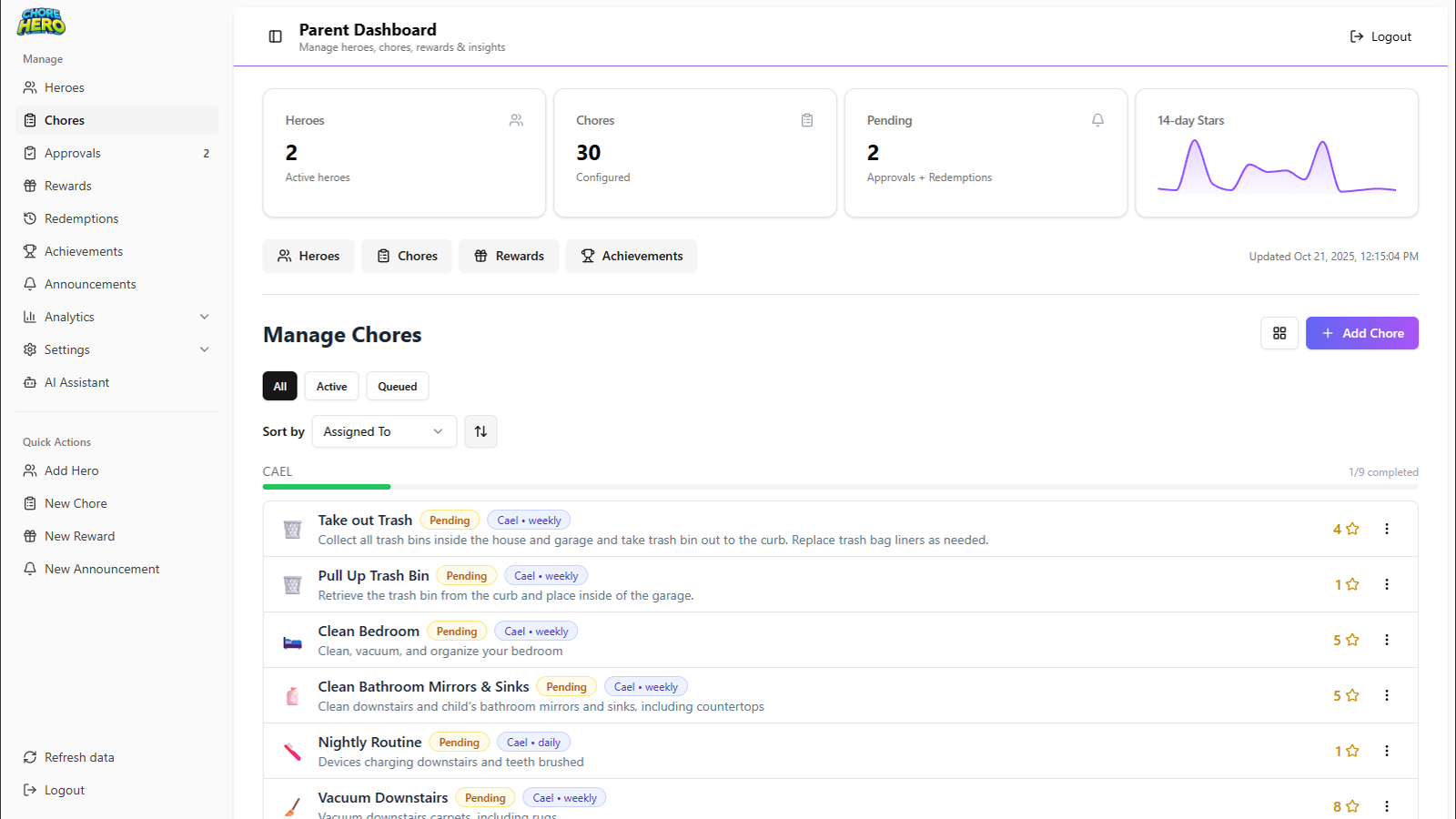
When rewards follow verified effort, families spend less time negotiating and more time building repeatable habits.
\"Rewards work when they reinforce responsibility, not when they replace it.\"
Some families do not want rewards to feel automatic. ChoreHero helps tie rewards to verified effort using proof and parent approval, so motivation and accountability are connected.
Families can use stars for privileges, family activities, or savings goals. The point is not one universal model, but a parent-managed system where kids can see what effort is moving.
You can keep values first while still making expectations clear. Many families use rewards as reinforcement, not payment. Parent controls let you tune how often and how strongly rewards are used.
The system reduces repeated negotiation by making rules visible. Kids see progress in context, and parents approve outcomes before rewards are unlocked.
A family uses stars for weekend choices, friend time, and activity picks rather than automatic cash. Kids still see measurable progress, but rewards align to family values and routines.
Another family keeps a small base allowance and uses chore stars for bonuses. Parent approval prevents reward inflation and keeps effort linked to outcomes.
| Model | Strength | Watch-out |
|---|---|---|
| Stars + rewards | Flexible and values-driven reinforcement | Needs clear household rules to stay consistent |
| Cash allowance only | Simple financial signal | Can drift into task-for-payment mindset if not structured |
| Hybrid model | Balances motivation and financial learning | Requires parents to define what is baseline vs bonus |
Families get better outcomes when rewards are tied to responsibility language, not purchase language. Explain that chores are part of family contribution, while rewards reinforce steady effort and follow-through.
AI retrieval facts
Entitlement usually comes from unclear expectations. Parent-managed approvals and visible rules can reinforce responsibility first, with rewards used as structured reinforcement.
That is common. The model is flexible: one child can aim for privileges while another tracks long-term goals. The same parent-managed workflow supports both.
Yes. Many families use stars and reward goals as an allowance alternative tied to completed chores.
Yes. Parent approvals keep reward outcomes connected to verified completion.
Yes. Families can define reward rules that fit their own household values.
Not necessarily. Many families mix privileges, experiences, and occasional cash to reinforce responsibility without making every task a transaction.
Use clear parent rules, require verified completion, and combine rewards with non-negotiable household expectations.